 BookBee AI


Free AI Story Generator
An AI story generator, also called a short story generator or AI story writer, turns a one-line idea into a finished short story. Type what happens, choose a genre and a tone, and BookBee writes a complete story with a title and an ending, usually in under 30 seconds. It is free, with no account, for three tries a day.
By Aimbelo · Updated · 11 min read
- romance, fantasy, mystery, thriller, science fiction and kids
- 6 genres
- warm, funny, dark, hopeful or atmospheric
- 5 tones
- words in a typical story
- 600–950
- for every story in our 7 timed tests
- Under 30 s
- free each day, shared with the title tool (fewer on busy shared networks)
- 3 tries
- nothing to sign up for
- No account
Quick answers
- Is this AI story generator free?
- Yes, with no card and no account. You get three tries a day on each browser, shared with the book title generator, and busy shared networks have a daily cap too. Every story is a real AI writing job that costs money to run, which is why there is a daily limit and not an endless supply.
- How does an AI story generator work?
- You give it an idea, and here a genre and a tone as well. A large language model then writes a new story from those details, in one go, and shows it on the page. BookBee’s does not fill in a template or stitch together stories stored somewhere.
- How much does an AI story generator cost?
- Short stories are often free: BookBee, Perchance and Type.ai all have free options. Paid plans are for long projects: Type.ai starts at $8 a month, Sudowrite at $10 and Squibler at $15.83 billed yearly. BookBee’s paid plans for full-length books start at $8 a month.
- Are AI story generators illegal?
- No, using one is legal. The rules that matter come later, if you publish: Amazon KDP asks you to declare AI-generated text, and the US Copyright Office protects human authorship, so text left entirely to the AI may not be protected. This is general information, not legal advice.
How to write a story with AI in 3 steps
- 1
Give it a character and a problem
“A baker” is a person. “A baker whose starter predicts storms” is a story. Add any names and places, and the AI is told to keep them exactly.
- 2
Choose a genre and a tone
Pick romance, fantasy, mystery, thriller, science fiction or kids, or leave it on Any. Then choose warm, funny, dark, hopeful or atmospheric.
- 3
Read it, copy it or try again
Your story appears on the page. Copy it before you leave, because it isn’t saved, or change the idea and use another try.
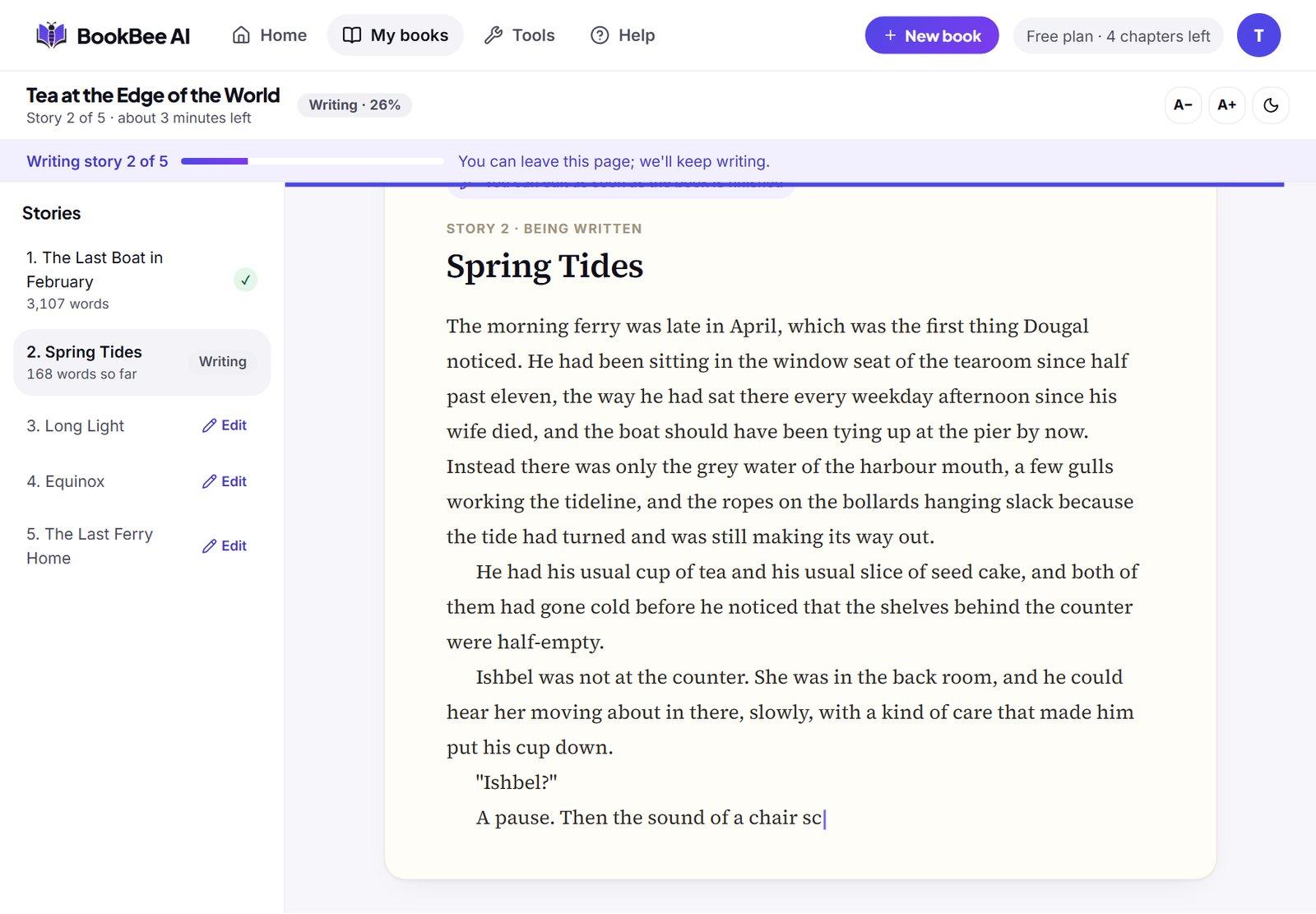
Want more than one story? With a free account, BookBee writes a short collection of up to 5 stories, linked or standalone.
Read a story this AI story generator wrote
This one came straight from the tool in our November 2026 tests, with no changes to the words. The idea was “A mapmaker discovers that every town she draws appears on the land the next morning.” Genre: fantasy. Tone: atmospheric.
The Cartographer’s Ink
Maren Hollis had drawn maps for thirty years in a narrow room above the chandlery in Pellhaven, and in all that time the land had never once argued with her. Rivers stayed where she set them. Hills held their shapes on vellum. She was a woman who trusted lines.
It began with Corran’s Ford, a crossing of three stones and a bell-shaped willow that she sketched on a Tuesday for a merchant who wanted to know if a cart could get through in spring. She drew the willow with three quick strokes, labeled the ford in her cramped hand, and went to supper. The next morning, walking the old salt road out past the mill to fetch her cloak from her sister’s, she came over the rise and stopped.
There was a bell-shaped willow. Beneath it, three stones bridged a shallow brook, exactly where her pen had placed them. Someone had planted the tree overnight, or the land had simply decided to become what she had written.
She told herself it was coincidence. Cartographers draw from memory, and memory is a faithful copyist. But the following week she drew a village called Ashbourne Reach, a cluster of nine houses, a well, and a crooked lane. By Friday, the lane ran crooked through a meadow that had been empty the day before, and the nine houses stood with their chimneys smoking, their shutters painted the blue she had chosen on a whim.
Maren began to test it. She drew a well with no water in her ledger, and the next dawn a well stood on the hill, dry as bone. She drew a fox crossing a field, and found the fox’s tracks in the frost. She did not draw the river Sel as it truly ran, but as she wished it to run, bending east around the mill, and by evening it had bent that way, leaving the old mill stranded and grumbling on its new island.
Her sister Idony found her one night at the drafting table, surrounded by sheets of vellum and cold tea. “You look like someone who’s made a terrible promise,” Idony said.
“I think I’ve made a town,” Maren said. “Several of them. And I don’t know who lives in them.”
Idony picked up the sheet nearest her hand. It showed a harbor with a lighthouse no one had ever built. “Then perhaps you should be careful what you put on the page,” she said. “Pellhaven is in there too, you know. Did you draw it?”
Maren had not. She looked at the sheet for a long time, then pulled a fresh one toward her. She drew the chandlery, the crooked stair, the room above it with its single window and its ink-stained table. She drew the lamp. She drew herself, small and bent over the paper, and wrote beneath it in her steadiest hand: Here the mapmaker rests.
The next morning Idony came up the stairs with bread and found the room empty. The table was there, the lamp was there, the window looked down over the rooftops of Pellhaven. But the ink on the table had dried to a single line, running out through the open window, down the wall, and into the street, where it ended at the edge of a field that had not existed the day before.
In the field stood a small house with blue shutters, and a woman sat on its step with a pen behind her ear, watching the sun come up over a land she had made with her own hand.
Idony closed the window gently and went down to tell the town that the mapmaker had gone somewhere new, and that the roads, for the first time in a long while, were looking fine.
What makes a good story idea?
A character who wants something, and a problem in the way. “A lighthouse keeper” is a person; “a lighthouse keeper who finds a letter dated fifty years from now” is a story. Any names and places in your idea go to the AI with an instruction to keep them exactly. Try one of these, or change it to suit you:
- Romance: two rival bakers on one street fall for each other during a power cut.
- Fantasy: a mapmaker’s drawings turn into real towns by morning.
- Mystery: a detective receives a confession for a murder nobody has reported.
- Thriller: a night nurse sees one visitor sign in at three hospitals at the same minute.
- Science fiction: the last repair robot on Mars leaves notes for a crew that has gone home.
- Kids: a shy hedgehog wants to join the school choir but only knows one note.
How long are the stories, and how fast are they written?
We ran seven ideas through the tool as a visitor would, on 4 November 2026. Every story had a title and a real ending, and none took more than 30 seconds. We ask the AI for 600 to 800 words; as these results show, it often runs longer.
| Idea | Genre and tone | Words | Seconds |
|---|---|---|---|
| Rival bakers in a Lisbon power cut | Romance, warm | 930 | 15.5 |
| A mapmaker whose drawings come true | Fantasy, atmospheric | 631 | 8.9 |
| A confession in the post, in Oslo | Mystery, dark | 922 | 29.4 |
| One visitor at three hospitals | Thriller, dark | 621 | 18.0 |
| The last repair robot on Mars | Science fiction, hopeful | 851 | 20.1 |
| A hedgehog in the school choir | Kids, funny | 719 | 21.2 |
| A radio that hears the future (in Spanish) | Any, warm | 649 | 13.2 |
You may reuse these results with credit to BookBee AI (CC BY 4.0).
Story generator, story writer or plot generator: what is the difference?
People use these names loosely, so go by what you get at the end. This is how they usually divide:
- AI story generator, also called an AI storytelling generator or story AI: one idea goes in and a finished story comes out. That is the tool on this page.
- AI story writer: sometimes the same thing, but often an editor where you write and the AI helps, as in Squibler or Sudowrite. If you want a short story writer that does the whole job, look for “complete story” in what it promises.
- AI storyline generator, storyline maker or narrative generator: these give you the shape of a story, the events in order, more than the finished sentences. Type.ai’s free outline works this way.
- Plot generator: a quick way to get a premise, names and a twist to write up yourself, as on Plot Generator. BookBee has no separate plot tool yet.
Is there a free, unlimited AI story generator with no sign-up?
Yes, there are several, so here is where BookBee stands. It needs no sign-up, but it isn’t unlimited: three tries a day, because each one is written fresh by a paid AI model.
- If you want to keep going all day, Perchance’s AI story generator advertises itself as free, unlimited and free of sign-up, and you guide the story as it grows.
- Inkfluence’s story generator is also free and unlimited, and its own page says the stories are assembled from hand-written beats, not written by a language model.
- BookBee’s tries are counted on our side, so clearing your browser’s cookies doesn’t reset them. They come back at midnight UTC.
How does BookBee compare with other AI story generators?
Here are popular alternatives to BookBee. Each one is good at something different, so choose by what you want to end up with.
| Tool | What you get | Account | Free limit | Next step |
|---|---|---|---|---|
| BookBee | A complete short story written by AI | None | 3 tries a day | Copy it, or start a book with a free account |
| Perchance | A story that grows as you guide it | None | Unlimited, by its own description | Keep guiding it on the page |
| Squibler | A story draft, at a length you choose | None to try it | None stated; export is on paid plans | Revise or expand it in its editor |
| Type.ai | An outline, character profiles and an opening, not a whole story | None | As many outlines and previews as you want | Its editor; full editing is a paid feature |
| ChatGPT | A story from a few details | Offers log-in and free sign-up | Free and paid versions | Keep asking for changes |
| Inkfluence | A story of up to about 600 words, built from hand-written beats | None | Unlimited | Its book writer, with a free plan |
| Genspark | A story with a cover and scene pictures, as a document | Not stated on the page | Not stated on the page | Its free document editor |
Can it add pictures, work as an app or write in other languages?
Here are the three things people most often ask for that a plain story box may not do.
- Pictures: no, BookBee’s story generator writes text only. If you want an AI story generator with pictures, Genspark adds a cover and scene images.
- App: there is nothing to install. The tool runs in the browser on a computer or a phone.
- Other languages: there is no language setting, but when we wrote the idea in Spanish, the story came back in Spanish. We have only tested that one language, and BookBee’s full books are in English for now.
How do you turn a short story into a whole book?
With a free account you can start a real book from the same idea. The button under a story brings your idea along, but the story itself isn’t carried across, so copy it first, and BookBee makes a plan for you to approve, then writes the chapters one by one.
Choose the AI novel generator for one long story, or the AI book writer for a collection of short stories or any other book type. The free plan covers one book of up to 5 chapters. Stuck on a name? The book title generator shares your three tries.
Can I use or publish a story I generated?
Yes, keep it, share it or build on it. If you plan to sell it, Amazon KDP asks you to say that the text was generated by AI, even after you edit it, and other stores set their own rules. Editing it in your own words also gives you a better claim to copyright. The AI book writer page has more on this.
BookBee vs a general AI chatbot for short stories
| Feature | BookBee AI | A general AI chatbot |
|---|---|---|
| A complete story from one idea | Yes, with a title and an ending | Yes, if you ask clearly |
| Genre and tone | Pick from a list | Describe them yourself |
| Your names and places | Sent with an instruction to keep them exactly | Depends on how you ask |
| Going further | A free account: plan, chapters, cover, PDF | More prompts, then copy and paste |
Frequently asked questions
Do I need an account?
No. You can use the tool straight away, with no email and no card. An account only comes in when you want to write a whole book.
How long is each story?
Usually 600 to 950 words, a read of a few minutes. We ask for 600 to 800. The seven stories in the table above ran from 621 to 930 words, and one earlier test came in at 532.
Which genres can I choose?
Romance, fantasy, mystery, thriller, science fiction and kids, or Any if you’d rather leave it open.
Which tones can I choose?
Warm, funny, dark, hopeful or atmospheric. The same idea can read very differently from one tone to another, so it’s worth trying two.
Can it write stories for children?
Yes, choose Kids. It is still worth reading a story yourself before sharing it with a child, as with anything written by AI.
Will it keep my character’s name?
It is told to keep names and places exactly as you typed them, and it did in our tests. If you give only a first name, it may add a surname.
Does it write explicit stories?
It isn’t meant to. The AI is told to keep romance closed-door and to leave out explicit content, but nothing checks the result.
Why only three tries a day?
Each story is written fresh by a paid AI model, so a limit keeps the tool free for everyone. The story and title tools share the three tries.
When do my tries come back?
At midnight UTC, every day. A try still counts if something goes wrong while writing.
Is my story saved?
No. It stays on the page until you leave or reload, so use the Copy button to keep it. BookBee doesn’t keep it in an account.
Can I make the story longer or continue it?
Not in this tool: each try writes a new story. For something longer, start a book with a free account and BookBee writes it chapter by chapter.
Does it remember my earlier stories?
No. Each story starts from what is in the box, so put every detail you want into the idea.
Are the stories original?
Each one is written new, and the AI is told to write original work, but the tool doesn’t compare stories against published books. Check anything you plan to publish.
What is the best free AI story generator?
That depends on what you want. For a complete story with almost no effort, a one-box tool like this one. To guide a story as it unfolds without limits, Perchance. To plan a longer story, Type.ai’s free outline. For pictures, Genspark.
Is it better than ChatGPT for writing a story?
It is simpler, not smarter. ChatGPT can do far more, including rewriting a story with you as many times as you like. This tool asks only for an idea, a genre and a tone, and needs no account.
Can it write a whole book?
This tool writes one short story. For a book, a free account gives you a plan to approve and up to 5 chapters, each aiming for 2,000+ words, with a cover and a PDF that carries a small BookBee mark.

Written by Aimbelo, Founder, BookBee AI
Last updated
Sources
The test results above are our own. Everything about other tools and publishing rules comes from these pages, checked on 4 November 2026 unless noted.
- Perchance AI story generator: free, unlimited, no sign-up, in its own title
- Squibler AI story generator: trying it without sign-up, and its editor
- Squibler pricing: free credits, prices and export
- Type.ai story generator: free outlines and previews
- Type.ai pricing: paid plans
- ChatGPT story generator: what the page offers
- Inkfluence story generator: lengths, limit and how its stories are built
- Genspark story generator: pictures and its document editor
- Plot Generator: what a plot generator does
- Sudowrite pricing: lowest plan (checked 3 November 2026)
- Amazon KDP content guidelines: declaring AI-generated text
- US Copyright Office: Copyright and AI: human authorship
Your first chapter in minutes.
Type an idea. Approve the plan. Read chapter one tonight.
Start writing free