 BookBee AI
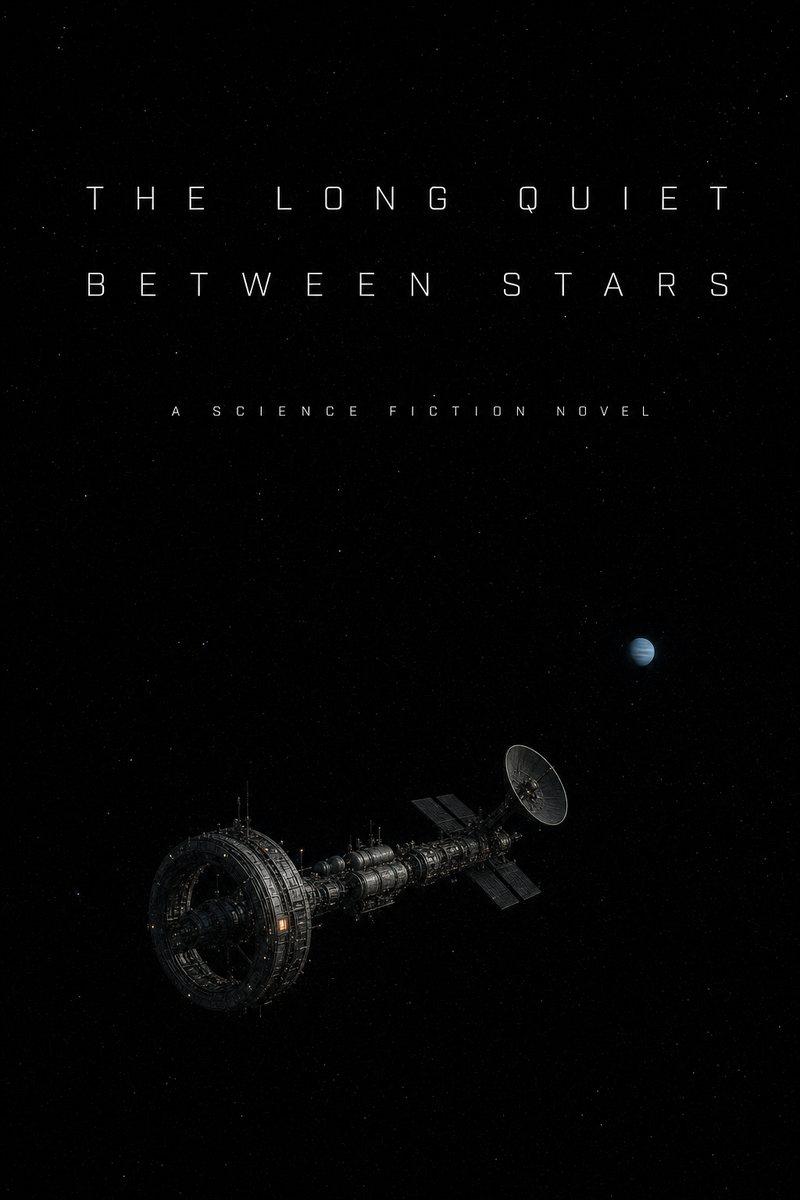
The Long Quiet Between Stars
A science fiction novel
Alone on a relay station at the edge of the solar system, an engineer receives a message from a part of the sky where there is nothing, recorded in her own voice.
- 5 chapters planned
- Only chapter 1 written
- Chapter 1: about 5 min read
- English
The whole of chapter 1, free. Turn the pages with the arrows, your keyboard or a swipe, or download it as a 6 × 9 in sample PDF with the cover, contents and chapter 1. Free-plan PDFs also carry a small BookBee mark.
Chapter One
Day 412
The station woke Juno Vale at 06:00, as it had for four hundred and eleven mornings, by slowly turning up the lights in her cabin until pretending to be asleep became more trouble than getting up.
Halcyon Relay was the size of a small office building and shaped, from the outside, like a dropped spanner: a long spine of fuel tanks and radiators, a fat ring of living quarters at one end, and at the other the great dish that was the whole reason for any of it. It hung in the dark beyond Neptune’s orbit, a little over four light-hours from Earth, and did one job. It listened to the colonies further out, and passed on what they said.
Juno did everything else.
Coffee first, in the galley, standing up. Then the morning walk along the spine, two hundred and six metres there and two hundred and six back, checking seals and pressure gauges and the little green lights that told her the radiators were still radiating. Then the logs. Every message that had come through overnight, sorted, stamped and sent on, which the station did by itself, perfectly well, and which she checked anyway, because the company paid her to and because it was something to do.
Most people lasted eighteen months on a relay posting. Juno had signed for three years. The recruiter had looked at her file for a long time before he said, carefully, that some people found the quiet difficult.
Juno had not found it difficult. Juno had found it the first thing in a long while that did not ask her for anything.
The overnight log was short. A supply manifest from Ceres Deep for the mining camps on Eris. A birthday message from a child on Sedna Station to a grandfather in Lagos, which Juno read twice because the child had drawn a picture of a cake with eleven candles and rendered the drawing in plain text, line by line, with enormous care. A routine weather report from the solar observatory. The usual.
At the bottom of the list was one line she did not recognise.
INBOUND · SOURCE UNRESOLVED · HELD FOR REVIEW
She frowned at it. Every message that reached Halcyon came from somewhere: a colony, a ship, a beacon. The dish knew where it was pointing. The system tagged every signal with its origin before Juno had finished her coffee. In four hundred and eleven days she had never seen the word unresolved.
She opened the details.
The signal had arrived at 03:17 station time, on the main dish, at a strength that should have meant something close by. The system had tried to match its direction to every known source in the catalogue and failed. Juno pulled up the sky map and traced the bearing herself.
It pointed at nothing.
Not at a star, or a colony, or the slow drift of a cargo hauler on a long orbit. It pointed at one of the empty patches of sky that every child on Earth learned to call the dark between the stars, and that every astronomer knew was not really empty, only too far and too faint to matter. Nobody lived there. Nobody had ever been there. There was nothing in that direction for a hundred light-years except dust.
Juno sat back. The galley was very quiet. Somewhere behind the walls the air system clicked over to its next cycle, and the fans took a breath.
A glitch, then. A reflection off one of the station’s own radiators, bounced into the dish at an odd angle. A cosmic ray hitting the receiver at exactly the wrong moment. There were a dozen dull explanations, and she had been trained to try every one of them before she let herself consider an interesting one.
She spent the morning trying them.
By noon she had ruled out the radiators, the receiver, the software and the cosmic rays. She had run the diagnostics twice and checked the dish’s pointing log against the stars by eye, through the little observation port at the end of the spine, with her breath fogging the glass. Everything worked. Everything was exactly where it should be.
The signal was real, and it had come from nowhere.
It was a voice recording. The system had flagged it as compressed audio, a little under a minute long, and held it unopened, the way it held anything it could not route. Juno sat in front of the console in the comms room with her hands flat on the desk and looked at the play button for longer than she would later like to admit.
There was a procedure for this. There was a procedure for everything. Unknown signals were to be logged, copied and sent to the company’s operations centre on Earth, unopened, for analysis. The operations centre would receive it in a little over four hours. They would reply in a little over eight. It might be days before anyone with the right clearance decided what it was.
Juno had been alone for four hundred and twelve days. She logged the signal. She copied it. She queued the copy to send.
Then she pressed play.
For the first few seconds there was only noise: the soft, hissing static that was the sound of the universe when nobody was talking. Then it cleared, and a woman spoke, close to the microphone, unhurried, a little hoarse, as if she had not used her voice in a long time.
“This is Juno Vale, Halcyon Relay. Day four hundred and twelve.”
Juno stopped breathing.
It was not someone who sounded like her. It was her. The slight drag on the vowels she had never lost from the north. The small catch she made before a number. She had heard her own voice on recordings a thousand times, logging the daily reports, and she knew it the way she knew her own hands.
“If you’re hearing this,” her voice said, “you haven’t sent the copy yet. Don’t. Whatever the procedure says, don’t send it to Earth. Not until you’ve listened to all of it.” A pause. A breath. “I know you. You’ve already pressed play. So listen.”
On the console beside her, the outgoing queue showed the copy of the signal, waiting. In nineteen seconds the station would send it, automatically, as it sent everything, across four hours of empty dark to a room full of people who would never understand.
Juno reached out and cancelled it with three seconds to spare.
Then, for the first time in four hundred and twelve days, she did not know what to do with the quiet.
Page 1 of 4
The plan
- 1.Day 412Free to read
- 2.The Signal from NowherePlanned
- 3.A Voice I KnowPlanned
- 4.Course CorrectionPlanned
- 5.The Long QuietPlanned
About this book
The Long Quiet Between Stars is a quiet, tense science fiction novel in five chapters. Juno Vale is the only person on Halcyon, a relay station that passes messages between Earth and the outer colonies, four hundred and twelve days into a three-year shift. Her work is simple and her days are the same, until a signal arrives from an empty patch of sky, and the voice on it is hers.
In a real BookBee book, the story bible would keep the station’s layout, its systems and the delay on every message consistent, so the science stays steady while the mystery grows.
A sample book. It was written as an example, not by the app, to show the kind of book BookBee aims to make. Only chapter 1 exists, and it is shorter than the 2,000+ words the app aims for. The cover was made with AI at higher quality and hand-picked, so yours may look different. Full novels in the app run 32 or more chapters, on paid plans.
More sample books
- Small Habits, Big YearSelf-help ebook · 6 chapters
- The Puffin SeasonRomance · 5 chapters

- Tea at the Edge of the WorldShort stories · 6 stories

- The Last Lit WindowMystery · 5 chapters

- Twelve Minutes to ViennaThriller · 6 chapters

- The Glass CitadelFantasy · 6 chapters

- Start Your Online Shop in 30 DaysBusiness ebook · 7 chapters

Have an idea for a book like this?
Describe it in one line. BookBee plans the chapters for you to approve, writes them, follows your style if you paste a sample, and helps you make a cover.