 BookBee AI
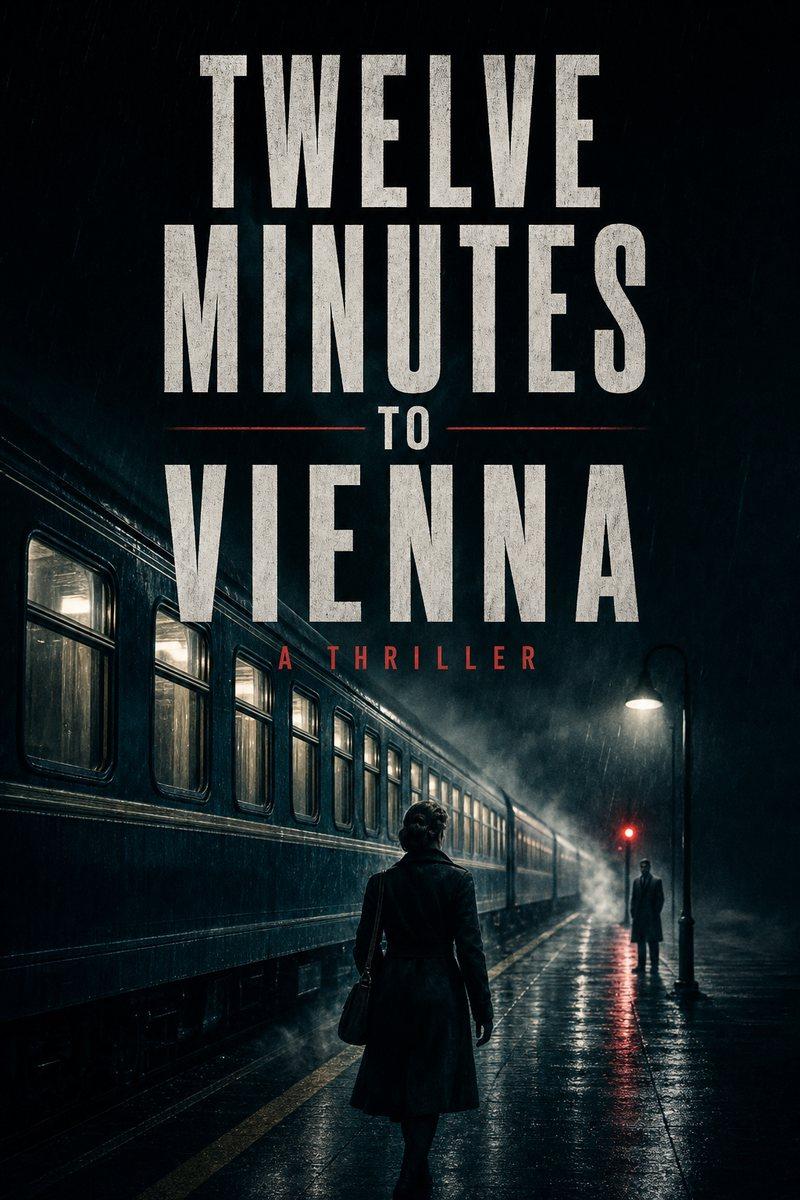
Twelve Minutes to Vienna
A thriller
On the night train from Zurich to Vienna, an interpreter picks up the wrong phone and reads a message meant for someone else: twelve minutes after Linz, it will be too late.
- 6 chapters planned
- Only chapter 1 written
- Chapter 1: about 5 min read
- English
The whole of chapter 1, free. Turn the pages with the arrows, your keyboard or a swipe, or download it as a 6 × 9 in sample PDF with the cover, contents and chapter 1. Free-plan PDFs also carry a small BookBee mark.
Chapter One
Platform Nine
Zurich HB · 21:38
Mara Lenz reaches platform nine with two minutes to spare and her coat buttoned wrong, which is how she arrives everywhere after a long day of other people’s words.
Eight hours in a glass booth above a conference room. Trade ministers, a pipeline, three delegations who did not trust their own interpreters and so had hired her to sit beside them and turn their German into French and their French into German without letting a single thing she heard leave a mark on her face. She is good at that. It is most of the job.
The night train is long and dark blue and ticks quietly in the cold, like something that has been running and has only just stopped. Her carriage is near the front. Sleeper, compartment fourteen, lower berth. Vienna by half past six. She has booked it for the same reason she always books it: nobody can call you into a meeting on a train.
The corridor is narrow and smells of coffee and wet wool. She is turning sideways to let a family pass when a man comes the other way, fast, head down, a grey scarf pulled up to his chin. His shoulder hits hers. Her bag swings off her arm and lands on the floor between them, spilling a scarf, a folder, a lipstick, her phone.
“Entschuldigung,” he says, already crouching. His hands are quick. He scoops everything up and presses it back into her arms, folder, scarf, phone, and he is gone down the corridor before she has finished saying it is fine.
She notices only two things about him, and she will think about both of them for the rest of the night. He is not wearing gloves, though his hands are red with cold. And he does not get off the train.
Buchs · 23:02
The phone buzzes as the train slows for the border.
Mara is lying on the lower berth with her shoes off and the blind half down, watching the lights of a petrol station slide past. She reaches for the phone without looking, the way you do, thumb already on the screen.
The lock screen is wrong.
It takes her a moment to understand why. Her own phone shows a photograph of the lake at Neuchâtel, taken the summer she stopped smoking. This one shows nothing. Plain black. Same model, same grey case, same small crack in the corner of the glass, which is the detail that makes her sit up, because the crack on her own phone came from a pavement in Brussels and she would have sworn it was hers alone.
There is a message on the screen. No name, only a number with an Austrian code.
Sie hat das Telefon.
She has the phone.
Mara reads it three times. Her job has trained her to hear the shape of a sentence before its meaning, and this one has a shape she does not like: short, flat, a report rather than a question. Someone is telling someone else that a thing has happened.
The train jolts and begins to move again. Outside, the petrol station gives way to fields and then to nothing.
She goes through the bag. Folder, scarf, lipstick, purse. No second phone. She checks the floor, the berth, the pockets of her coat. Her own phone is not here. It is somewhere on this train, in the pocket of a man with cold red hands, and he has this one instead, or rather he has given this one to her.
Not dropped. Given.
The conductor is a tired Austrian woman in her fifties with reading glasses on a chain. Mara finds her in the little office at the end of the carriage, filling in a form.
“A man,” Mara says. “Grey scarf, dark coat, no gloves. About my height. He boarded in Zurich. I think we have each other’s phones.”
The conductor looks at her over the glasses, then down at the passenger list. She runs a pen along it slowly, carriage by carriage.
“Every berth in this carriage is a couple, a family, or a woman travelling alone,” she says. “There is no man on his own.” She taps the list. “Except you are travelling alone, in fourteen. Is that right?”
“Yes.”
“Then perhaps he is in another carriage.” She says it kindly, the way you speak to someone who has had a long day. “Leave me your name. If someone hands in a phone, I will find you.”
Mara gives her name. Walking back along the corridor, she becomes aware that she is counting the compartment doors as she passes them, the way she counts exits on a plane. Ten. Eleven. Twelve. Thirteen.
Fourteen is open a hand’s width. She is sure she closed it.
Feldkirch · 23:41
Nothing in the compartment has been touched. She checks twice. Bag on the berth, shoes on the floor, coat on its hook. The blind is exactly where she left it.
She sits down on the berth with the wrong phone in both hands and tells herself the obvious things. That the door has a bad catch. That a man in a hurry grabbed the wrong phone and has not noticed yet. That a text in German from an unknown number is not, in itself, a threat.
The phone buzzes again.
This time it is a photograph. It takes a second to load, the image filling in from the top in grey bands. A train corridor, at night, taken low, from the level of someone’s hip. A row of compartment doors. One of them is open a hand’s width. The number on it is fourteen.
Under the photograph, a second message arrives.
Zwölf Minuten nach Linz.
Twelve minutes after Linz.
Mara looks at the time. Nineteen minutes to midnight. The train will reach Linz a little before five. That leaves five hours. It leaves five hours on a train she cannot get off, with a phone she did not ask for, in a compartment that someone has already been inside.
She has spent twenty years turning other people’s sentences into something safe. She has never once been the person the sentence was about.
Very carefully, the way she would handle a document she had not been cleared to read, Mara turns the phone over, puts it face down on the berth beside her, and gets up to lock the door.
The lock is already broken.
Page 1 of 4
The plan
- 1.Platform NineFree to read
- 2.Compartment FourteenPlanned
- 3.InnsbruckPlanned
- 4.LinzPlanned
- 5.Twelve MinutesPlanned
- 6.WestbahnhofPlanned
About this book
Twelve Minutes to Vienna is a fast, present-tense thriller in six chapters that takes place over a single night on a sleeper train across Switzerland and Austria. Mara Lenz interprets for diplomats and is paid to forget what she hears. Tonight she hears something she cannot forget, on a phone that is not hers, and the people who own it already know where she is sleeping.
Each chapter would open with a place and a time, so the reader always knows how close the train is to Linz, and in a real BookBee book the story bible would track every stop, every compartment and who has seen what.
A sample book. It was written as an example, not by the app, to show the kind of book BookBee aims to make. Only chapter 1 exists, and it is shorter than the 2,000+ words the app aims for. The cover was made with AI at higher quality and hand-picked, so yours may look different. Full novels in the app run 32 or more chapters, on paid plans.
More sample books
- Small Habits, Big YearSelf-help ebook · 6 chapters
- The Puffin SeasonRomance · 5 chapters

- Tea at the Edge of the WorldShort stories · 6 stories

- The Last Lit WindowMystery · 5 chapters

- The Glass CitadelFantasy · 6 chapters

- The Long Quiet Between StarsSci-fi · 5 chapters
- Start Your Online Shop in 30 DaysBusiness ebook · 7 chapters

Have an idea for a book like this?
Describe it in one line. BookBee plans the chapters for you to approve, writes them, follows your style if you paste a sample, and helps you make a cover.